Zero Proof Lessons from Prohibition-Era Thanksgivings

“Will it be turkey -- plump and luscious; the more delicate milk-fed chicken; or a goose fattened for the sacrifice? Will your table groan under a huge roast of beef, a juicy leg of lamb or succulent pork?” The dishes, whichever you choose, don’t matter much, a 1921 ad said, as long as you paired dinner with the right drink.
But in Nov. 1921, the second Thanksgiving of the Prohibition era, wine and whisky were a no-go (at least openly).
A Thanksgiving newspaper ad that ran in the New York Tribune on Nov. 20, 1921 tried to solve that era’s hostessing conundrum: What do you serve for Thanksgiving dinner if you can’t serve wine?
The answer, at least according to this ad: An extra-dry ginger ale.

A Clicquot Club ad from 1922.
The Clicquot Club Ginger Ale is “a living, bubbling beverage that will add its share of joy to the occasion,” and it’s “a real Thanksgiving drink. Served cold enough to quench the most aggravating thirst, yet it has an inborn warmth that will not chill the body or the mind.” (In today’s terms, we’d describe Clicquot Club as a craft soft drink locally produced in Millis, Massachusetts.)
Ginger ale, root beer, sarsaparilla and birch beer, the early ancestors of today’s soft drinks industry, aimed to position themselves as the zero-proof stars of their time. Promising the same rich flavors of then-banned spirits, they were often positioned as delivering “warmth” of flavors without the inebriation of cocktails.
The Nov. 1922 Thanksgiving ad Clicqout Club ran promised a drink that would please many, and not dampen the celebratory mood. “It fits in so sociably with the mood of the day -- its good taste, its spicy fragrance, its lively bubbles -- they are all part of the jolly, happy merrymaking.” The central concept of the ad is an idea that rings true today: A successful zero proof drink aims to deliver a flavorful experience as much as it does provide a mood-lifting experience.
For a country long accustomed to serving wines during holiday dinner, the move to non-alcoholic Thanksgiving (and its ensuing questions about dinner pairings) required a learning curve.
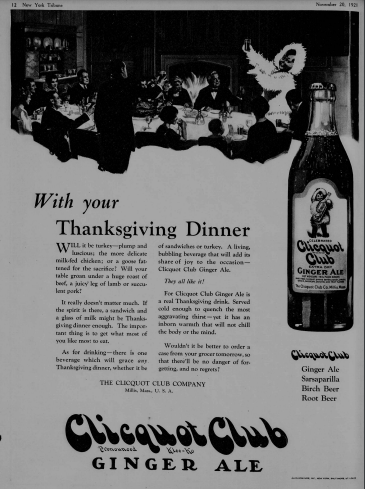
A Clicquot Club ad from 1921.
In 1916, just a few years before Prohibition went into effect in 1920, a typical newspaper ad in the Washington Herald read: “The turkey may be the piece de resistance of the Thanksgiving Day table, but wines and cordials are indispensable to the full measure of the day’s zest and enjoyment.” The company, To-Kalon, offered “wines that go well with turkey” such as Sauternes, Claret, Sparkling Burgundy and Champagnes and bottled Martinis, Manhattan and dry Martinis for $1.10 per bottle.
By 1921, however, hostesses needed new guidance. The Washington Evening Star’s Nov. 16 1921 “Women’s Page” section (ahem) published etiquette tips on holiday seating arrangements (siblings should not be seated next to each other) as well as a suggested holiday dinner plan. The paper’s ideal menu included iced grapefruit, oysters on the half shell, salted almonds and olives, as well as roast turkey with sage dressing and brown gravy, baked corn, cranberry jelly, baked potato cake and pumpkin pie, among other dishes.
What liquid goes best with this rich meal? “Sweet cider may be served with the dinner, or grape juice,” the editors note.
One hundred years later, the good news is that there’s never been more excellent zero proof options than ever, which is its own cause for celebration. For those who want to dip into a small glass of wine or whisky with dinner, that’s ok, too.
As today’s holiday gatherings begin to take shape, the focus, happily, is on celebration and conviviality, not what is or isn’t restricted on the dinner menu.
Why Water Gave Non-Alcoholic Drinks a Terrible Reputation

Why did it take . . *checks watch* until the 2020s for the zero proof movement to gain steam in America?
One reason, among many: Blame water.
It’s not entirely water’s fault, to be sure.

But water, at the time of the founding of the American colonies, had a worse reputation than whisky. With good reason: Drinking bad water was credited with the massive failure of the Jamestown colony, which was founded in 1607 as a sober community.
As I write in my book, “’Zero Proof: 90 Non-Alcoholic Recipes for Mindful Drinking”, early settlers did not set up a brew house when they landed, which meant they didn't have the technology to kill microorganisms. (The idea of boiling water to make it safe was still some decades away.) Settlers lived off river water, which had a high level of salt content, and gave themselves salt poisoning, among many other issues. So began a decline that led to mass starvation and death.
When Plymouth’s settlers arrived to set up their own colony in 1620, they made sure to set up a brewhouse nearly right away. A brew house, famously, was one of the very first structures that the Plymouth settlers built, with a public house that became the center of social, political and civic life. These early gestures begin the weaving of drinking with socializing in America, a practice that continues to this day.
For colonial settlers, fermenting beer, which was part of the first Thanksgiving meal, was a way to make water drinkable. For many decades, and even centuries later, people knew one thing: Drinking beer and liquor was, in some ways, safer than drinking water. Towns and cities in both the colonies and in Europe were beset with cholera outbreaks, for example, that originated at public wells and town pumps.
The advent of piped water helped lift water’s reputation. (Incidentally, the Roman Empire had mastered safe piped water in buildings and cities, but that technology was lost for centuries after the Empire’s fall.) By the colonial era, urban myths as well as documented illnesses linked to water, meant that drinking water (and tangentially, most non-alcoholic drinks) was viewed with suspicion, not entirely without reason.

By the late 1800’s, the popularity of sparkling mineral waters in America as well as Europe started to ease public fears. Cities such as Philadelphia added piped water to buildings at the start of the 1900s. But water was still sketchy enough that newspapers would often publish tips and advice on how to drink water.
A typical article from 1903, for example, tells readers about the best time to drink water (upon rising, before means and half an hour before sleeping). “Not more than two glasses of water or other liquid should be taken at meal time, and practically no water should be drunk when soup is served,” an article published on Sept. 9, 1903 in South Carolina’s Lancaster Enterprise said. “Water may be taken at the close of a meal, but if many glasses are drunk with meals, disorders of digestion may follow, in fact, the desire to drink copiously at meal time is often an evidence of indigestion.”
Public comfort with drinking water helped fuel the early temperance movements of the 1800s, which sought to make non-alcoholic drinking more socially acceptable. Many hurdles later, including surviving the vast unpopularity of Prohibition, the non-alcoholic drinking space is perhaps at long last, shaking off centuries of bad press. It’s been an uphill battle to be sure, but one reason it’s taken so long, besides the lack of quality options, was a built-in resistance to the non-drinker that goes back to before America was America.
Sober October Enters the Chat in 2005

Sure, working out is hard. But have you tried not drinking for a month?
According to Factiva, a database of over 33,000 newspapers, blogs and other publications, the earliest mention of 'Sober October' as a non-drinking holiday appears in the LA Times in Dec. 2005.
The story (summarized more in Stories) profiles a few fitness buffs who tried to give up drinking that previous Oct.
The Times' Jeannine Stein wrote: "Skipping alcohol boosts workouts, the instructor vowed. But few counted on the peer pressure."
"It was really hard," says participant Lala Alvarez. "I told people I was laying off the alcohol, and there was this pressure -- 'Have a drink with us! This drink tastes fantastic!' I'm like, stop it."
Stein hits on themes we all recognize: the startling amount of peer pressure ("One friend was so perturbed by her lack of alcohol that she had to hold a glass of wine in her hand to make him feel comfortable.") as well as the benefits (". . . found it gave him more confidence, improved his memory and boosted his energy").
Stein's article was published on Dec. 12, 2005. It is later re-published in the Toronto Star, the Kitchener-Waterloo Record, the Cincinnati Post and the South Florida Sun-Sentinel.
In 2008, the phrase returns as charity groups, moving on the popularity of 'Movember' ask people to give up booze for 'Ocsober.'
The Non-Alcoholic Cocktail Is As Old as Cocktail Culture Itself
People who are suspicious of the zero-proof drink will often sneer at it, and may even suggest that it’s a made-up phenomenon that doesn’t deserve the respect of the bar world itself. Here’s the thing, though: The non-alcoholic drink is as old as cocktail culture itself.
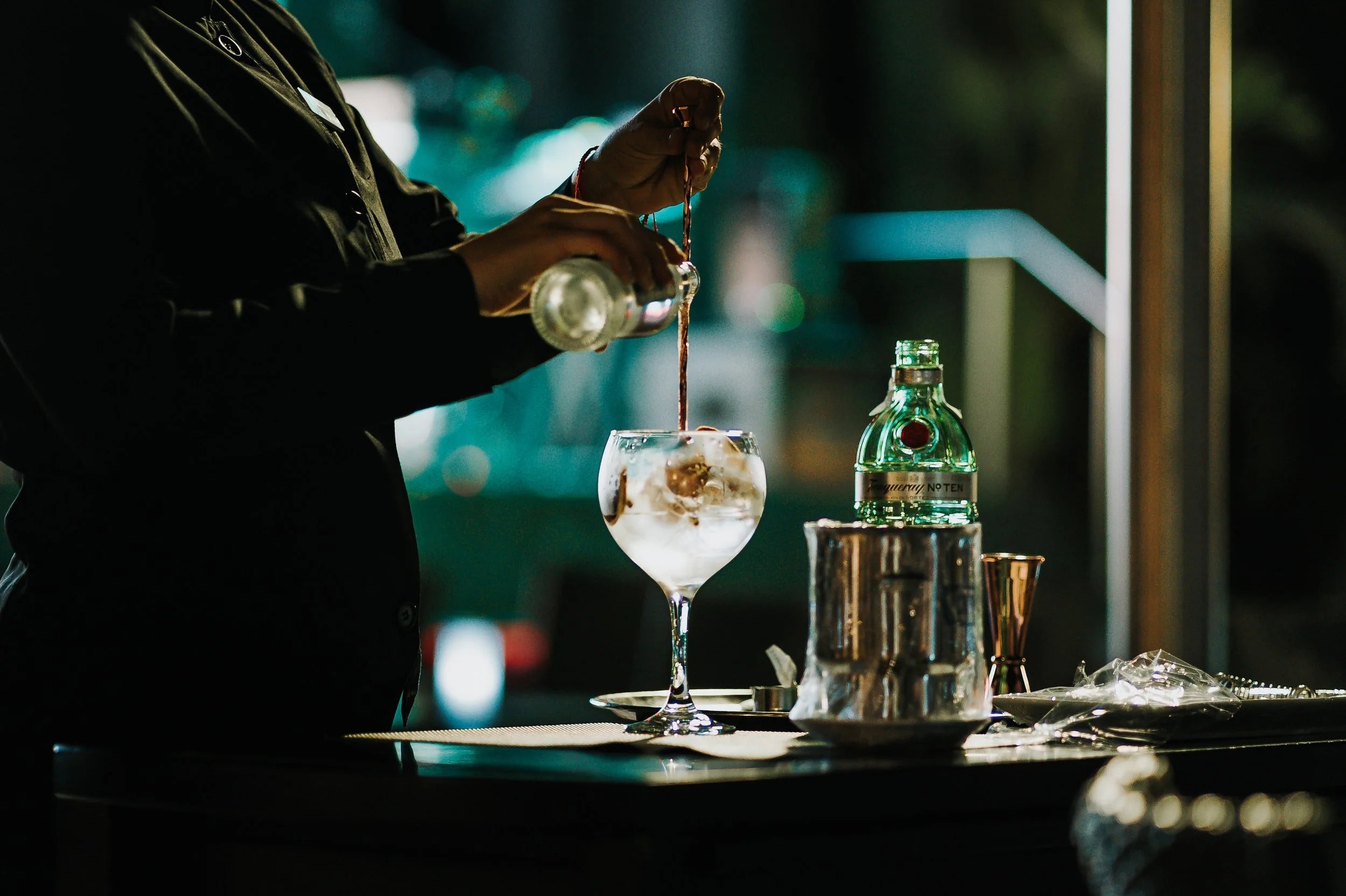
Put another way: The oldest American cocktail books, which are the basis for contemporary bar culture, feature non-alcoholic drink recipes alongside early recipes for mint juleps, whiskey sours and Manhattans.
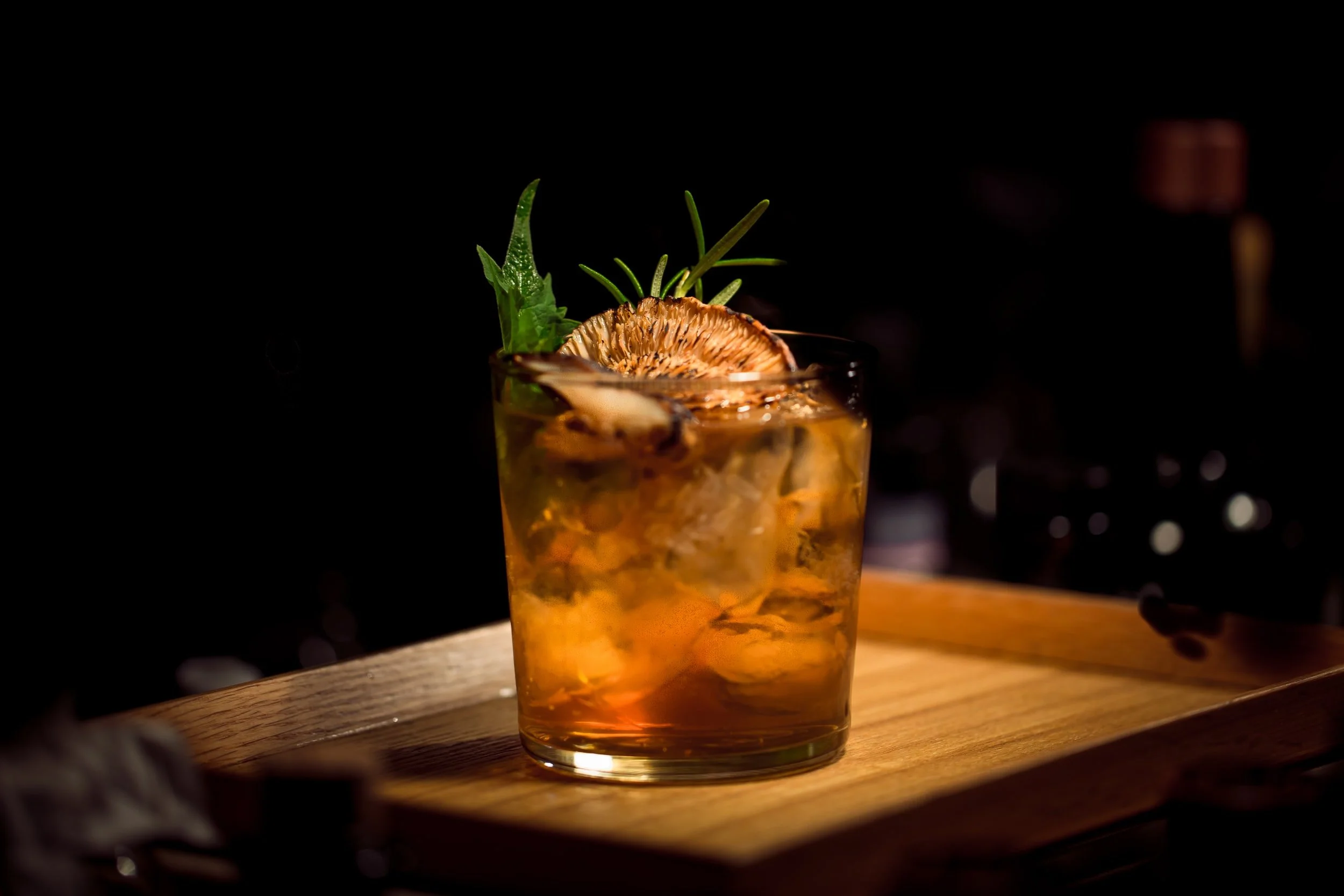
Whether it’s called a temperance drink or a mocktail or zero-proof, the non-alcoholic drink has been here all along. It’s not an afterthought to boozy drinks. It is a sister category that sits alongside the fizzes, coolers and punches that define the pre-Prohibition cocktail era.
Jerry Thomas’ “Bar-tenders Guide: How to Mix All Kinds of Plain and Fancy Drinks,” published in 1862, is considered by historians to be the first cocktail book as we know it, compiling recipes of the golden age of cocktails. A section, called Temperance Drinks, includes the specs for drinks such as the soda cocktail, orgeat lemonade, Saratoga cooler and milk & seltzer (a precursor of the egg cream).
William “Cocktail” Boothby published his seminal recipe compilation in 1891 in San Francisco. “Cocktail Boothby’s American Bar-Tender” featured nearly 400 recipes for mixing “absinthes, cocktails, coolers, cobblers, crustas, fixes, flips, fizzes, hot drinks, lemonades, punches, sangarees, shakes, toddies, etc,” according to the title page. Boothby’s non-alcoholic drinks are listed in the Lemonades sections, which include variations made with raspberry syrup, orgeat syrup and even raw eggs. (Raw eggs, shaken into drinks with ice and citrus, are often found in early cocktail recipes; when emulsified, they lend drinks a frothy, silky texture.)
“Stuart’s Fancy Drinks and How to Mix Them,” published in New York in 1896 by Thomas Stuart, also features a Temperance Drinks section, with lemonade riffs as well as orangeade, soda nectars and sherbets, which appear to be the early ancestors of today’s fizzy flavored soft drinks.
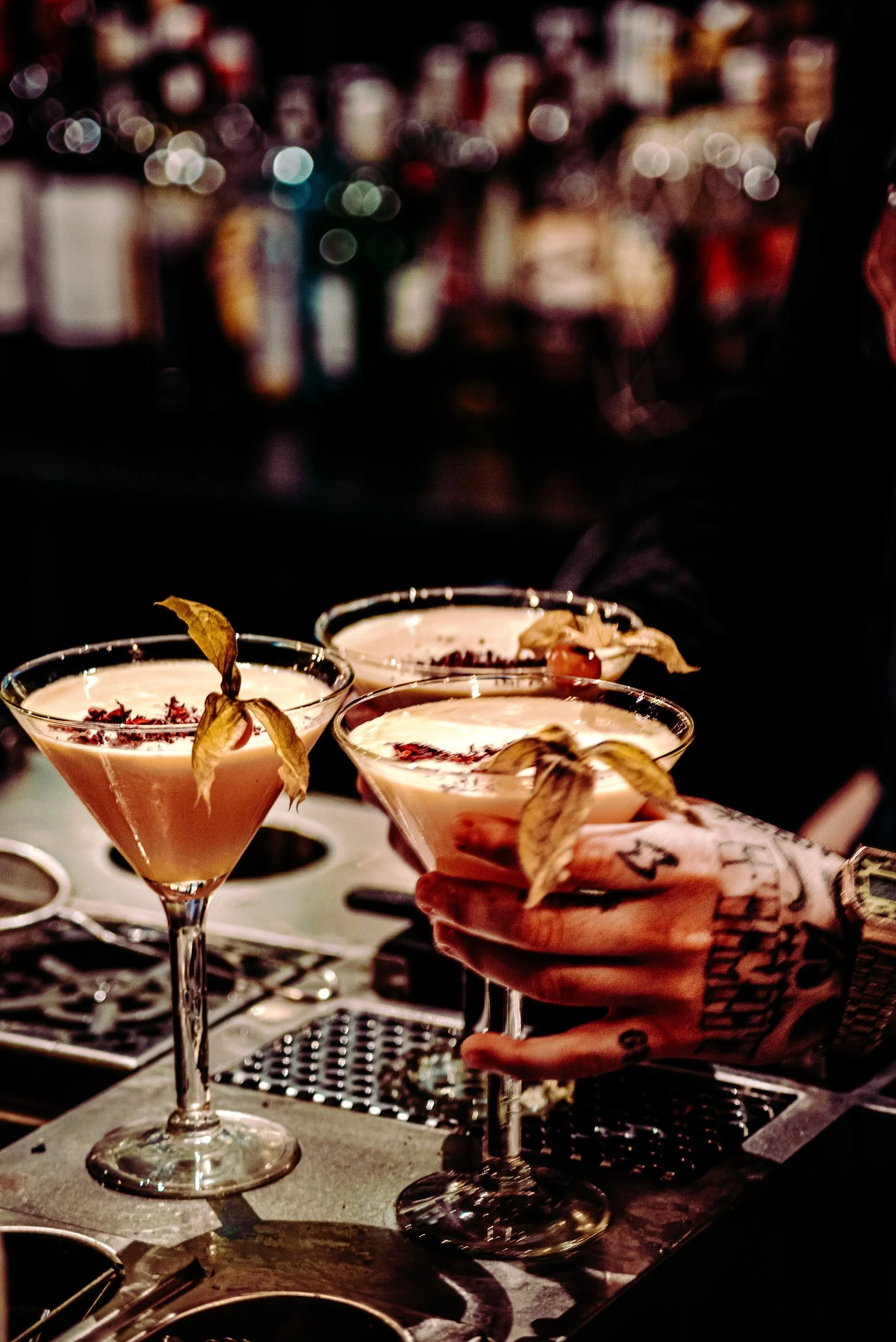
That temperance drinks were given space within the pages of early cocktail titles points to their presence at bars from the start. To be sure, this was a smaller section of recipes, as opposed to say, the multiple punch and sling recipes. But that the non-alcoholic drink was included in early books illustrates two points: The non-alcoholic drink was requested enough at turn-of-the-century bars that professional barmen needed to know several popular recipes; and Thomas, Boothby, and Stuart, as the foremost mixologists of their era, afforded temperance drinks respect by including them in their recipe compilations from the very beginning.
While the road to respect is still long for the non-alcoholic drink, it clearly emerged during the golden age of cocktails. The zero-proof drink has the same historic bona fides as the martinis, Manhattans and juleps that have come to symbolize pre-Prohibition authenticity.
It’s time to give the zero-proof cocktail the respect it deserves.
One of The Earliest Colonial Buildings Was a Brew House
One of the first American colonies in Jamestown, Virginia was founded in 1607 by a group seeking "a sober lifestyle and a healthy diet".
It failed.
Miserably.
Colonists gave themselves salt water poisoning and died of starvation. Jamestown's failures was one reason why the Plymouth colonists, upon setting up camp in Nov. 1620, made it a priority to build a brewhouse. A tavern followed soon after.
The inaugural Thanksgiving, held in the fall of 1621, featured beer made using the settlers’ first barley crop.
These two historical moments (a well-founded suspicion of water and a cultural life built around the tavern) will go on to impact American drinking to this very day.
These are just some of the reasons why drinking in America is deeply woven into social etiquette, and why the non-drinker is frequently viewed with suspicion.